They are mainly used in installations requiring large flow rates, abnormally high working pressures (cast steel, S.G.iron) or special temperatures or pressures respectively. Their installation requires heavy foundations and extensive piping configurations. The high flow velocities within the pump body and the pump ports often require special noise attenuation measures.
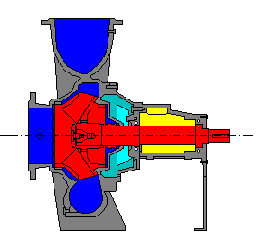
The following diagram depicts a sectional view of a flexibly-coupled end-suctionpump without motor, coupling and baseplate.
The pumps can be directly pipe mounted or, if necessary, be separately supported by foundations or brackets.
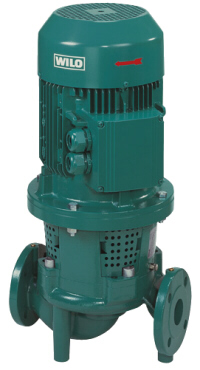
The high continuous temperature rating (up to 140°C) and the vibration-free operation on account of respectively shaped pump housings, impellers and drive motors are the decisive design features of this, especially for building services developed pump design. Low flow velocities through the housing as well at the pump ports make special noise attenuating measures (flexible connections) superfluous.
A centrifugal pump is a hydraulic flow machine in which the transport of the pumped medium is realized by utilizing the centrifugal forces (centrifugal forces) caused by the rotation of the impeller. Energy is transferred by deflecting the flow within the impeller blades.
Centrifugal pumps are typically applied for pulse free, continuous or intermittent operation, but they are not suitable for dosing or metering applications. The strengths of this process are in the continuous, pulsation-free operation. Another advantage is the relatively simple design and good adaptability, which avoids high maintenance costs.
The application is limited with regard to the viscosity of the pumped medium. With increasing fluid viscosity the efficiency is decreasing. Therefore the application is practically limited to fluids with a kinematic viscosity up to 100 .. 150 mm²/s. For higher viscosities positive displacement pumps are preferred.
Important parameters are head, flow rate, power requirement, efficiency and NPSH value. The parameters are generally shown as performance curves depending on the volume flow (flow rate).
There are different types of piston pumps (reciprocating piston pumps):
the submersible piston pump, also called plunger pump,
the disc piston pump and
the diaphragm pump.
By asynchronously opening and closing the inlet respective outlet of the pump chamber, the fluid will moved in the pump chamber and then pressed to the discharge side.
Reciprocating pumps are generally used for applications that require relatively low flows and high pressures. Since each cylinder delivers a definite volume of liquid to the system, these pumps are also applicable for dosing and metering tasks. The disadvantage against rotating pumps is the pulsating operation.
Liquid pumps are divided into centrifugal pumps and positive displacement pumps according to their operating principle. There are also special designs such as jet or mammoth pumps.
A single-start conveying spindle rotates in a double-start worm housing made of elastic plastic.
The eccentrically rotating screw conveyor conveys the medium in the free screw channel of the housing from the suction side to the discharge side in a continuous flow.
Eccentric screw pumps are particularly suitable for the transport of highly viscous fluids, mushy, slurry or paste-like media. Like screw pumps, they are suitable for highest viscosities where the use of centrifugal pumps is not possible.
In building services, especially for pumps for heating and air-conditioning technology, the classification of the pump design according to the sealing (wetting of the motor) is widespread:
Design
Description
Glandless Pump
Glandless pump with canned rotor motor
Glanded Pump
Centrifugal pump with shaft seal
In addition, the subdivision according to the type of installation or the arrangement of the drive is common:
Monobloc with flange-mounted motor
DIN-standards with motor and coupling on common baseplate
The required shaft power of the pump is given as a performance curve depending on the flow rate. The performance curve changes when the speed of the pump changes in accordance with the affinity laws.
The shaft power of the pump is directly proportional to the density of the pumped medium. In the case of highly viscous media, the shaft power also depends on the viscosity.
Depending on the application and size of the pump, the drive is designed so that the motor power is either greater than or equal to the viscosity of the pumped medium.
the shaft power at the operating point or
the maximum power of the characteristic curve,
in each case plus a security surcharge of at least 5%.
The required safety margin depends on the required engine power. While the safety margin is reduced to up to 5% for larger motors, surcharges of over 20% are applied for smaller power values. In addition, the nominal motor power for standard motors must be converted to the ambient conditions.
P2 is used as the symbol for the shaft power.
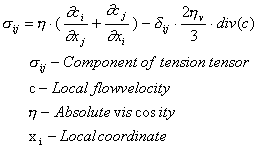
Newtonian fluids, at laminar flow, create shear tension and pressure super-imposed normal tensions which are proportional to the deformation velocity, the proportionality factor being the absolute viscosity.
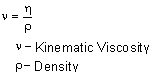
The kinematic viscosity is defined as:
The viscosity depends on temperature and pressure, whereby pressure dependency of fluids is of negligibly small characteristics.
Viscosity of non-Newtonian fluids can moreover be time-related (thixotropic or rheopexic flow characteristics); its characteristics then becoming undefined.
The viscosity of a medium has an influence on both the system curve and the pump performance curve. For centrifugal pumps, the pump curves are converted in practice at a kinematic viscosity of more than 10 mm²/s.


 The kinematic viscosity is defined as:
 The viscosity depends on temperature and pressure, whereby pressure dependency of fluids is of negligibly small characteristics.
Viscosity of non-Newtonian fluids can moreover be time-related (thixotropic or rheopexic flow characteristics); its characteristics then becoming undefined.
The viscosity of a medium has an influence on both the system curve and the pump performance curve. For centrifugal pumps, the pump curves are converted in practice at a kinematic viscosity of more than 10 mm²/s.
The viscosity depends on temperature and pressure, whereby pressure dependency of fluids is of negligibly small characteristics.
Viscosity of non-Newtonian fluids can moreover be time-related (thixotropic or rheopexic flow characteristics); its characteristics then becoming undefined.
The viscosity of a medium has an influence on both the system curve and the pump performance curve. For centrifugal pumps, the pump curves are converted in practice at a kinematic viscosity of more than 10 mm²/s.