Why Chlorine Gas Still Plays a Key Role in Drinking Water Disinfection After More Than 100 Years
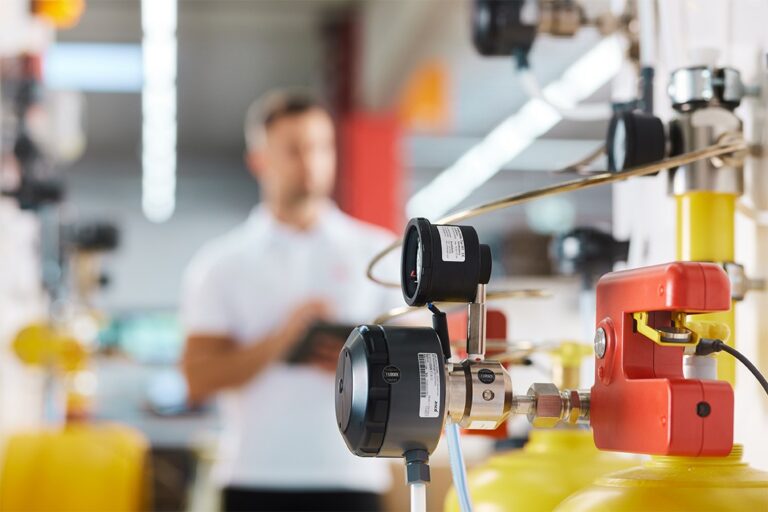
Lutz-Jesco develops system solutions for the safe dispensing of chlorine gas from pressurized cylinders (Image source: Lutz-Jesco GmbH)
Lutz-Jesco will demonstrate why this method continues to play a key role despite modern alternatives at the ExpoApa 2026 trade fair, held from 8 to 10 September in Bucharest.
In 2024, according to the Romanian statistics office, only 77.6 per cent of the population were connected to the public water supply. This means the country faces the task of further expanding its distribution networks. Two key challenges are involved here. Firstly, the water must reach households in a perfectly hygienic state, even when it has been flowing for a long time through extensive networks. Secondly, expansion must be carried out in a cost-effective manner in view of limited financial resources. According to the Organisation for Economic Co-operation and Development (OECD1), annual investments in the water supply would have to more than double in order to meet EU requirements and improve the efficiency of the systems.
All of this raises the question of how the microbiological safety of drinking water in Romania can be ensured without unnecessarily driving up operating costs?
“Modern disinfection technologies such as electrolysis and chlorine dioxide have undoubtedly greatly expanded the options available in water treatment. However, when it comes to disinfecting large volumes of drinking water, chlorine gas remains the most economical solution,” says Michael Raabe, Sales Manager at Lutz-Jesco. For decades, the company has been developing and manufacturing dosing technology and system solutions for water treatment. “Chlorine gas is cost-effective, delivers results even at low concentrations and can be dosed with high precision. Above all, its effect does not end at the output of the waterworks. A defined residual chlorine content can protect the water against recontamination as it travels through the pipeline network.” He adds that, particularly for large water volumes and extensive networks, this combination of effectiveness, long-lasting residual action and cost-effectiveness is a key advantage.
The disinfecting effect of chlorine has been known for a long time. As early as the beginning of the 20th century, chlorination became established in public drinking water supplies. While the underlying mode of action remains relevant today, the technology for dosing, monitoring and safety has been continuously refined.
Lutz-Jesco chlorine wall: a system solution for safely dosing chlorine gas
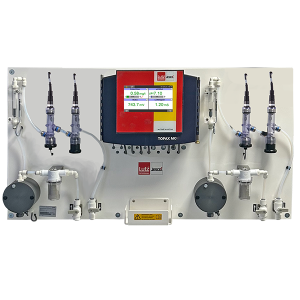
At ExpoApa 2026, Lutz-Jesco will present its 'chlorine wall', a system solution for dosing chlorine gas from pressurised cylinders. The system operates on the vacuum principle to minimise the risk of uncontrolled chlorine gas leaks. It uses ejectors that work according to the Venturi principle, generating a fast water jet that causes negative pressure. This sucks in the chlorine gas from the cylinder and injects it in the water. A booster pump supplies sufficient quantities of motive water at constant pressure to ensure that the process remains stable. A regulation valve controls the amount of chlorine gas dosed. This can be controlled automatically and as required, for example via a central PLC or the TOPAX controller from Lutz-Jesco integrated into the EASYPRO water sampling station.
Diaphragm pump for precise dosing of treatment chemicals
In addition to its chlorine gas technology, Lutz-Jesco will be showcasing further solutions for drinking water treatment at ExpoApa 2026. One of these is the Memdos Smart LPX, a diaphragm pump for dosing treatment chemicals. Its special feature: the pump works with a microprocessor that permits asynchronous operation of the motor. This means that the diaphragm moves at a higher speed during suction and at a lower speed during discharge. This produces a low-pulsation supply stream that permits precise dosing with even pressure, and a repeat accuracy of +/- 1 per cent.
With the solutions showcased at ExpoApa, Lutz-Jesco demonstrates how established water treatment processes can be combined with modern dosing, measuring and safety technology. “When expanding large distribution networks in particular, it is crucial to combine microbiological safety, reliable technology and economical operation”, Raabe concludes.
1 https://www.oecd.org/en/publications/oecd-economic-surveys-romania-2026_4844067e-en/full-report/enhancing-resilience-to-climate-risks_ae66c1bc.html?utm_source=chatgpt.com
Source: Lutz-Jesco GmbH