Dosing Chlorine Gas Safely and Sustainably in an Industrial Context
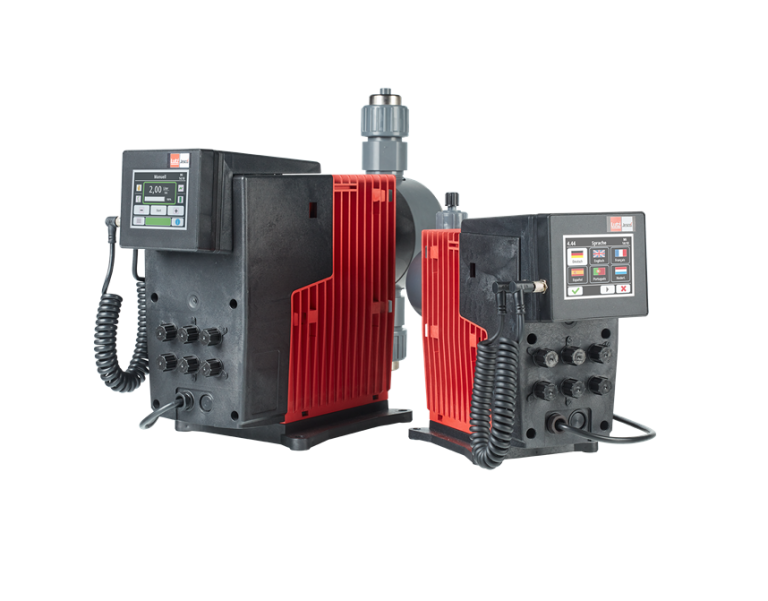
The Memdos Smart is a diaphragm pump for the precise and thereby sustainable dosing of aggressive chemicals in industrial and water treatment contexts. (Image source: Lutz-Jesco GmbH)
The solution: deployment of a system solution for chlorination as will be presented by Lutz-Jesco at the Ecomondo 2025 trade fair at the Rimini Expo Centre in Italy. Lutz-Jesco will also be presenting microprocessor-controlled dosing pumps from the Memdos Smart series and the EASYPRO water sampling station, which optimizes the use of the chemical.
“We are one of the few providers in the world active in the area of chlorination that is able to provide all the system components from a single source”, says Mahmoud Parsamanesh, project engineer at Lutz-Jesco. “The approach of providing everything from a single source reduces project times, improves performance and makes for increased safety”.
Lutz-Jesco will demonstrate the possible structure of a system solution using a chlorine wall at this year’s Ecomondo. A pressurised cylinder of chlorine gas is used to introduce this dangerous gas into water under a vacuum, so that the gas is unable to escape following a leakage. Ejectors work in accordance with the Venturi principle, generating a fast water jet that causes negative pressure. This sucks in the chlorine gas from the cylinder and injects it in the water. A booster pump supplies the motive water at constant pressure to ensure that the process remains stable.
The gas flow can be controlled via the C7700 regulation valve. This enables an automatic, needs-driven control, for example via a central PLC control or the Topax controller installed in the Easypro water sampling station The system can be supplemented by the CondiChlor, a chlorine gas filter and pressure reducing valve with a moisture eliminator. “This prevents the condensation of liquid chlorine, protects the system against impurities and increases operating safety”, explains Mahmoud Parsamanesh.
Chlor-Stop interrupts the gas flow in a fraction of a second
Two further components ensure safety during operation: the C2213 vacuum regulator keeps the vacuum system constant, prevents a return flow into the chlorine cylinder and thus protects the system. The Easycon gas warning device is also deployed to monitor the ambient air. As soon as the concentration exceeds pre-defined limit values, the device issues an alarm with an acoustic warning and flashing lights. The Chlor-Stop safety valve also interrupts the gas flow directly on the tank valve. Emergency systems such as sprinkler systems or gas scrubbers can also be activated automatically to provide additional protection following an accident. “The system provides a solution for the safe storage, monitoring and dosing of chlorine gas and facilitates the maintenance of standard-compliant working sequences”, says Mahmoud Parsamanesh.
The Memdos Smart dosing pump: exact and sustainable dosing of chemicals thanks to a microprocessor
Lutz-Jesco will also be showcasing the Memdos Smart at the Ecomondo, a diaphragm pump for the precise and thereby sustainable dosing of aggressive chemicals in industrial and water treatment contexts. Its special feature: the pump works with a microprocessor that permits asynchronous operation of the motor. This means that the diaphragm rises at a higher speed with suction and at a lower speed during ejection. This produces a low-pulsation supply stream that permits precise dosing with even pressure and a repeat accuracy of +/- 1 percent. Many conventional diaphragm and piston dosing pumps on the other hand, cause errors if they perform intermittent instead of even dosing.
The Memdos Smart is available in two sizes to cover a wide performance spectrum. The smaller version conveys between 2.6 and 30.7 litres per hour, the larger between 58.5 and 182 litres per hour. These two versions are both available in different materials such as PVC, PP, PVDF, and stainless steel to ensure compatibility with chemicals such as fluoride, hydrofluoric acid, peracetic acid, or concentrated sulphuric acid. The Memdos Smart is operated via a 3.5 inch, intuitively-operable full-colour touch display similar to a smartphone. Accessory parts are also available to facilitate installation and commissioning. This includes connection sets with suction lines, injection nozzles, pulsation dampers and back-pressure and pressure relief valves.
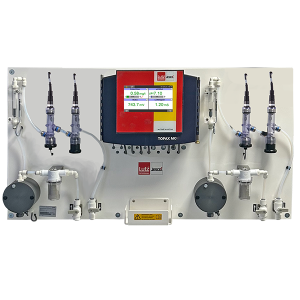
A further exhibit that will be showcased at the trade fair is the Easypro water sampling station. This provides a modular solution for the monitoring and control of various water parameters such as chlorine, pH and Redox in industrial, drinking water, wastewater and pool applications. “Its precise measuring system makes for the optimal use of chemicals and the saving of resources”, says Mahmoud Parsamanesh. “It also enables continual data capture, simple analysis and long-term increases in efficiency”.
Source: Lutz-Jesco GmbH