Plug-and-Play Emergency Chlorination for Safer Drinking Water
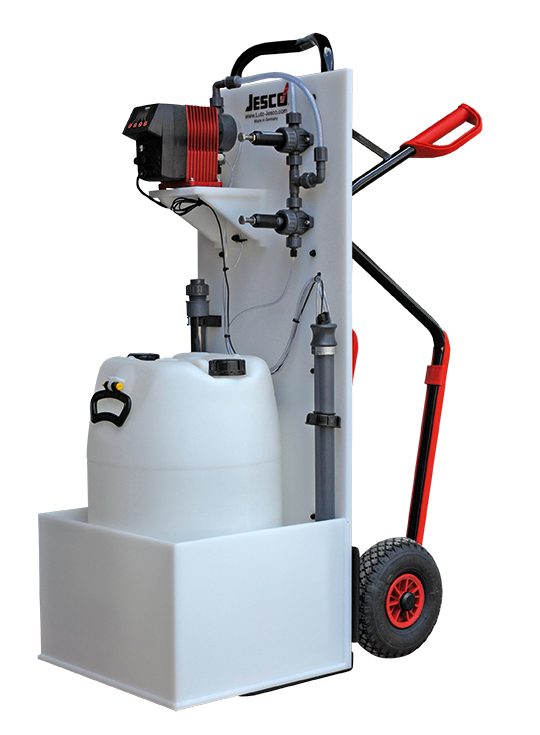
Ready for emergencies: the SAFETYCHLORMIX mobile emergency chlorination system from Lutz-Jesco (Image source: Lutz-Jesco GmbH)
Lutz-Jesco will also be presenting its new VakuStop, a safety shut-off valve combined with a vacuum regulator that enables waterworks to handle chlorine gas cylinders more safely.
If the bacterial count in drinking water rises – for example due to impurities due to heavy rainfall that has washed soil into a spring catchment chamber – waterworks must react quickly to avert a health hazard for thousands of households. The situation becomes critical if, for example, bacteria develop in an intermediate storage tank, and the permanently installed local disinfection systems are unable to cope. “We have developed SAFETYCHLORMIX for just such cases," says Cristian Meyer, expert in drinking water technology at Lutz-Jesco. “This mobile dosing system enables waterworks to act quickly and effectively to bring bacterial development under control through the precise dosing of liquid chlorine.” The emergency chlorination system has already been purchased by several municipal utilities in large cities such as Schwerin (Germany). The solution is not only deployed in waterworks but also in response to other special challenges relating to the safety of drinking water – such as Legionella contamination in the water supply for a high-rise building. “There is currently no comparable system available on the market,” says Meyer.
A single person can easily pull the system to its place of use
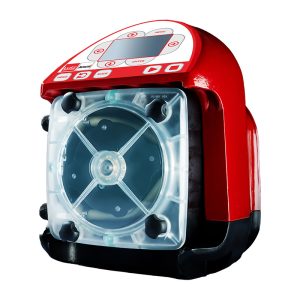
Lutz-Jesco offers SAFETYCHLORMIX as a plug-and-play system mounted on a robust tubular steel trolley. This means that a single person can easily pull the system to wherever it is needed and start emergency chlorination immediately. At the heart of the system is the Magdos LDp diaphragm dosing pump, which injects a calcium hypochlorite solution into the contaminated water from a container via a ten-metre PVC hose. The chemical releases hypochlorous acid (HOCI), which kills microorganisms through oxidation. “The pump impresses with exceptional durability, reliability and ease of maintenance,” explains Meyer. “Its magnetic drive means that it does not need any wearing parts such as gears or shafts.”
SAFETYCHLORMIX enables chlorine production of up to 650 g/h
SAFETYCHLORMIX is available in different performance levels, which enable chlorine production from 18 to 650 g/h. The delivery rate varies between 0.5 l/h and 15 l/h. The chlorine granulate is available in two package sizes: 25 or 60 litres. For added safety, the system is equipped with a back-pressure valve that regulates the line pressure and a pressure-relief valve that prevents positive pressure. A polyethylene collecting pan provides additional protection by collecting any leaking liquids and thus preventing the uncontrolled escape of chemicals into the environment.
Source: Lutz-Jesco GmbH