Performance or efficiency? Choosing the Right Pump
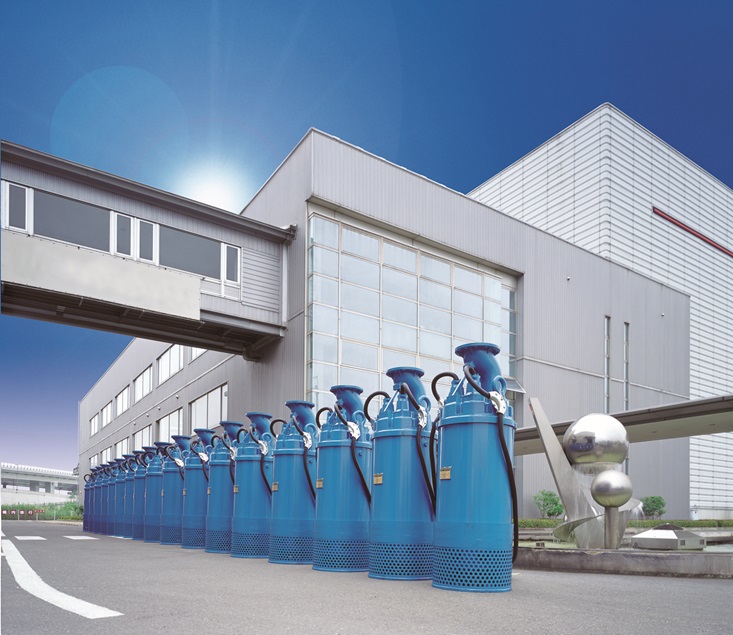
With so many pumps to choose from, it's hard to decide. Efficiency is an important criterion, but in many cases pure performance is what counts (Image source: Tsurumi)
It is not efficiency alone that determines the success or failure of a pump, but often the ability of the units to withstand extreme conditions. ‘A highly efficient pump that fails after a short time in practice is practically worthless,’ sums up Stefan Himmelsbach from the manufacturer Tsurumi Pumps. ‘In demanding areas, robustness is paramount.’ In three scenarios, performance comes first.
High-performance pumps: heavier, more robust – but often cheaper
Abrasive media such as sand, gravel or sludge require the use of high-performance pumps. Their rotors consist of thicker and heavier components, and the impellers are less delicate, which means they are more resistant to wear and tear. The disadvantage is obvious: this design compromises efficiency, as blunter blades and more solid parts require more energy to operate.
However, practical experience shows that the energy consumption is low in relation to the savings in maintenance and spare parts costs. ‘When an excavation pit fills up and the pump fails, we're not talking about kilowatt hours, but about downtime costs that can run into the thousands,’ explains the expert. High-performance pumps are therefore not only the better technical choice, but also the more economical one.
Solids as a disruptive factor: special pumps ensure operation
The conflict of objectives becomes even clearer when it comes to solids in water. Construction site water often contains not only sludge, but also wood residues, plastic pieces or other foreign objects – just like municipal wastewater. Such materials are poison for standard pumps: they clog, block or wear out in no time.
Special pumps with cutting, grinding or vortex technology provide a remedy here. Vortex pumps, for example, have impellers that are deeply embedded and do not lie directly against the suction plate. The additional space allows even coarse particles to be transported almost unhindered. This significantly reduces contact between the impeller and solids – and thus wear.
The price for this is lower efficiency. But here too, efficiency is irrelevant if the system is at a standstill. ‘Choosing a pump is always a strategic decision. It means that we accept higher consumption in order to reliably prevent failures,’ according to Tsurumi.
Time-critical applications: When every second counts
A third category of applications are temporary or acute uses – such as water drainage after heavy rainfall or in disaster control. In such situations, it is not important whether the pump operates at ten percent higher efficiency. The only thing that matters is that it moves large amounts of water within the shortest possible time and functions reliably.
Practical examples show that action often has to be taken within minutes to prevent consequential damage to buildings or infrastructure. ‘Energy efficiency is simply not an issue in such cases,’ Himmelsbach explains. ‘The performance of the pump determines the extent of the damage.’
Economically sound: higher consumption, lower costs
At first glance, sacrificing efficiency may seem counterintuitive – especially in times of rising energy costs. However, for users, focusing on performance can quickly pay off: stable operation, shorter maintenance intervals and predictable spare part cycles are more important in terms of overall costs than pure energy consumption – especially since this can be significantly reduced with level electrodes on the pump or ‘smart’ connectivity. There is a wide range of pumps on the market: for example, Tsurumi, with its EU headquarters in Düsseldorf, Germany, has over 500 models with flow rates of up to 30 m³/min or delivery heads of up to 216 m available for immediate delivery. Consultation is important, as it helps you find the right pump quickly.
Source: Tsurumi (Europe) GmbH