Pfeiffer Vacuum+Fab Solutions Launches New Turbopump
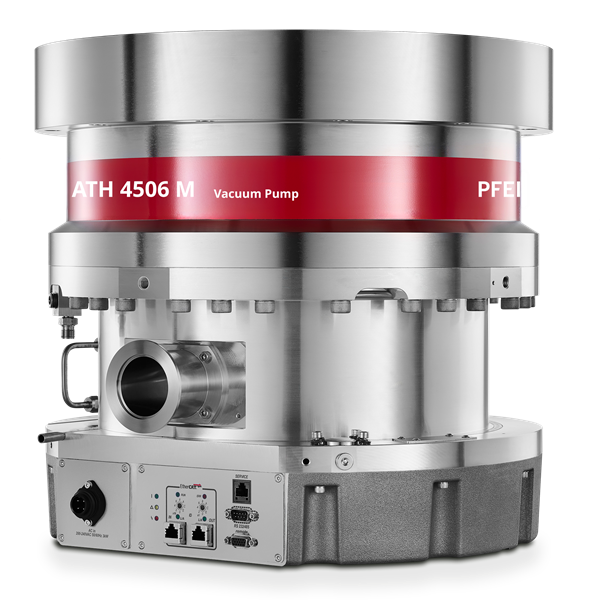
The new ATH 4506 M turbomolecular pump. (Image source: Pfeiffer Vacuum+Fab Solutions)
With a pumping speed of 4,500 l/s for nitrogen, the new turbopump is suited for processes in semiconductor manufacturing, large-area coating, and other applications where high gas throughput is required, such as the evacuation of large vacuum chambers for space simulation.
Plug&play operation with integrated controller
The ATH 4506 M comes with an integrated controller. This eliminates the need for separate external control units, which simplifies installation and reduces the space required in the system setup. The vacuum pump reaches its full rotational speed of 23,500 rotations per minute (rpm) in only nine minutes, meaning that production processes can be started quickly. For periods of inactivity, an idle mode lowers power consumption, contributing to energy-efficient operation.
Temperature management adapted to process needs
Depending on the process conditions, different operating temperatures are required. For this reason, the ATH 4506 M is available in two versions:
- A non-heated version for clean, non-corrosive applications where additional heating is unnecessary, such as large area coating.
- A version with a temperature management system (TMS) up to 90 °C for semiconductor manufacturing and other corrosive processes where moderate heating prevents condensation and particle formation.
By matching the vacuum pump temperature to the process, the ATH 4506 M minimizes condensation and particle buildup inside the pump, reduces wear on internal components, and prevents unplanned downtime. This leads to greater reliability, consistent product quality, and lower total cost-of-ownership for the user.
Condition monitoring and digital integration
The ATH 4506 M is equipped with internal sensors that monitor temperature, purge conditions, rotational speed, and off-axis movement. These measurements allow operators to track the status of the vacuum pump in real time, making it easier to detect irregularities at an early stage. This helps avoid unscheduled downtime and supports predictive maintenance. As the vacuum pump is IoT-ready, it can be connected to digital monitoring systems, enabling integration into automated production environments.
With IP54 protection, the vacuum pump is safeguarded against dust and splashing water. This increases its resilience in demanding industrial environments and extends service life.
Source: Pfeiffer Vacuum GmbH