New Series of Intelligent Diaphragm Pumps from Tapflo
Tapflo is proud to announce that a series of Intelligent diaphragm pumps has been implemented into company’s pump range portfolio. TC Intelligent pumps are fitted with ingenious LEAP technology developed by Tapflo.
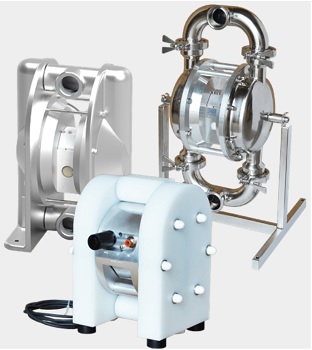 LEAP or ‘Low Energy Air Pump’ is a patented technology used in AODD pumps to reduce the minimum operating air pressure by reducing internal losses and friction found in conventional AODD pumps. - LEAP uses a unique indirect system to detect the position of the diaphragm shaft controlling the diaphragm movement automatically- explains Colin Wreyford Technical Director at Tapflo.
Key Benefits of the TC Intelligent pumps:
- Ultra low-pressure operation – reduced energy consumption.
- Impossible to stall – revolutionary control technology completely prevents stalling.
- Available in Plastic, Metal and Sanitary series AODD pumps – TC50 - TC425 (T50 - T425 equivalent).
- Retrofit – Leap can be fitted to any existing Tapflo Air Operated Diaphragm Pumps
- Improved Lifespan – LEAP uses a seal-less air valve technology with significantly longer life expectancy over conventionally sealed vales.
- Noise Reduction – lower air pressure = less noise of the pump.
- Simplified Maintenance – main air valve can be changed in less than two minutes without the removal of the pump from the process line.
- Simplified Control – integral solenoid valve control negates the need for an external pneumatic solenoid valve, reducing costs and simplifying control.
- Electrical feedback – integral VFC output signal allows for external monitoring of pump strokes.
- Batch Dispensing – using the integral VFC output and an external predetermining counter the pump can be automatically stopped after the required volume has been dispensed.
- Dry Running – monitoring the frequency of the output pulses from the pump can determine if the pump is running dry due to increased stroke rate.
- Dead Heading – as with dry running, the frequency of pulses can be monitored, alerting if the pump has a blockage.
Energy savings
The extensive testing procedure has shown that the largest amount of energy required by a pump is used to overcome the resistance created by the pump itself. – says Colin Wreyford.
Another major issue is found in the mid-port scenario, wherein the attempt to save energy by turning down the air pressure to a much lower level causes the stall of the pump.
The TC Intelligent pump is able to start pumping at 0.1 bar without stalling. In test the TC pump was already achieving flow rates of 70 percent of its maximum open end flow before other pumps had even started . At 0.3 (4.5 Psi) bar a standard Tapflo T50 pump fitted with LEAP technology was already pumping at over 25 L/min, while all other air pumps tested failed to even start. To achieve the same flows and control other pumps required 1.2 bar pressure.
Tests undertaken to measure the performance of a standard pump against the new TC pump have resulted in an energy saving of up to 70 percent.
Source: Tapflo AB