A Real Advantage for Quality Assurance: Monitoring Process-Related Pressures
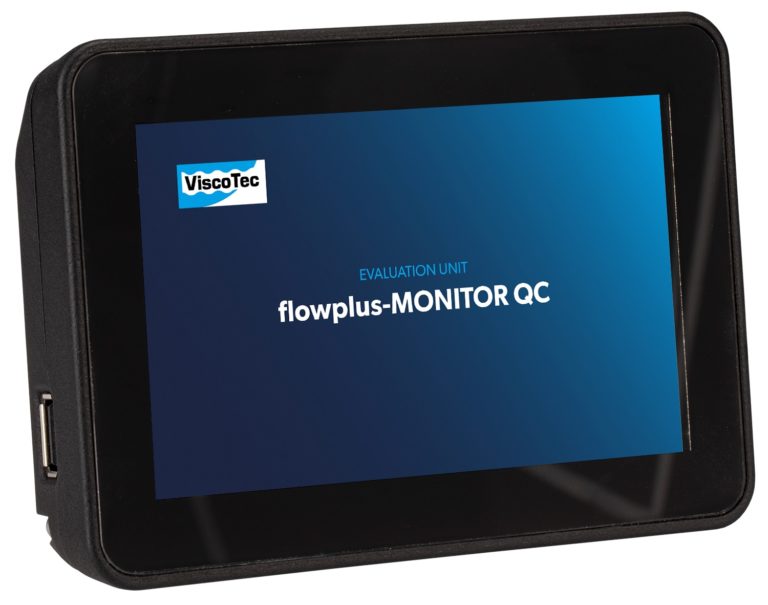
flowplus-MONITOR QC (Image source: ViscoTec Pumpen- u. Dosiertechnik GmbH)
It is suitable for monitoring 1-component and 2-component systems. Optionally, one channel can also be assigned with the inlet pressure and the other with the signal for the dosing pressure. The above-mentioned application versions open up more quality assurance options, especially for customers with older control models: The data can be recorded, saved and evaluated. The measurement values are exported and documented via the relevant interface using a USB stick. This interface is also used to install updates for the analysis unit.
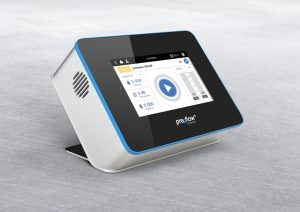
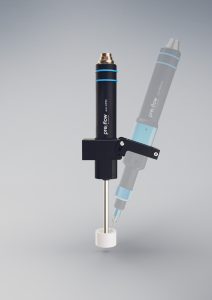
Furthermore, the flowplus-MONITOR QC has a 15-pin sub-D interface, which makes connection to higher-level systems as smooth as possible. Start-up is easy with Plug & Play; the sensors are connected to standardized, four-pin M8 flange sockets. Voltage signals between 0 and 10 V are processed, which makes the analysis unit together with the flowplus16 or flowplus-SPT M6 sensors the optimal quality assurance instrument. You can easily switch between the respective value ranges of 0-16 bar (flowplus16) or 0-40 bar (flowplus-SPT M6) in the settings. Thanks to the 5” color touch display, using the flowplus-MONITOR QC analysis unit is very intuitive. Pressure signals and limit curves are displayed in one view – various screen levels ensure detailed parametrization of the measured values. Colored graphics make it easy to record the contents. Additionally, users have the option to evaluate their pressure signals via preset limit curves and ranges. These values are determined using Teach-In on the touch display. The analysis unit works in a temperature range of between +10°C and +40°C and is in protection class IP20. Depending on the technical framework conditions, users can operate the flowplus-MONITOR QC analysis unit either with a pedestal or mount it on individual brackets using the thread holes on the back. The flowplus-MONITOR QC analysis unit helps customers to safeguard their processes by detecting air inclusions in the material and recognizing blocked dosing needles, thus enabling error-free component production.
The flowplus-MONITOR QC analysis unit replaces the previously known flowscreen.