Data center boom in Southeast Asia: Tropical climate makes cooling a challenge
The demand for computing power is rising worldwide. Artificial intelligence, cloud applications, and the digitalization of the economy are driving the expansion of large data centers. Southeast Asia is among the most dynamic growth regions. According to calculations by the International Energy Agency (IEA), electricity consumption by data centers in the region is expected to more than double by 2030 compared to 2024. Real estate services provider CBRE also sees a significant shift in new investments from established locations to emerging markets in Southeast Asia.
Malaysia is experiencing particularly strong growth. The Johor region, bordering Singapore, is developing into one of Asia's most important data center locations. According to Cushman & Wakefield, the project pipeline there, including existing facilities, reached approximately 3,100 megawatts in the first half of 2026. Thailand is also catching up: In Bangkok, the capacity under construction increased significantly to 859 megawatts. Further investments are concentrated in Indonesia and increasingly in Vietnam. While Singapore continues to be considered an established technology hub, the availability of land and energy limits further expansion there.
Tropical Climate Increases Cooling Requirements
As data centers grow, the demands on cooling technology increase. Unlike in temperate climates, Southeast Asia experiences high temperatures and often high humidity year-round. This limits the effectiveness of natural cooling methods, which, for example, benefit from low ambient temperatures in Northern Europe. Instead, operators often have to rely on energy-intensive technical cooling systems. According to Singapore's IMDA (Industrial Digital Administration of the USA), cooling can account for up to 40 percent of a data center's total energy consumption.
However, energy consumption is only part of the challenge. For water-based cooling systems, the availability of suitable cooling water also plays a crucial role. In open cooling towers, some of the water evaporates, while salts and other substances accumulate in the remaining system. To limit deposits, corrosion, and microbiological contamination, the water must be regularly exchanged and treated. Therefore, water-saving methods and the reuse of treated water are becoming increasingly important, especially in regions with limited water resources.
Water and energy efficiency are thus becoming a location factor
Singapore demonstrates how drastically the requirements are changing. The city-state has developed specific standards for the energy-efficient operation of data centers under tropical conditions. This includes gradually increasing operating temperatures to 26 degrees Celsius and above. According to the IMDA, operators can save two to five percent on cooling energy for every additional degree. In August 2026, a separate standard for liquid cooling in tropical data centers was also introduced.
In Malaysia, too, resource issues are increasingly coming into focus. A study by the Singaporean research institute ISEAS shows that the rapid expansion, particularly in Johor, is placing considerable demands on energy and water supply. The study calls for greater consideration of environmental impacts and infrastructure costs. As a result, efficient cooling systems, water treatment, and the reduction of freshwater consumption are becoming increasingly important criteria for new data center projects.
Cooling water treatment
This increases the need for industrial water treatment and wastewater treatment. Especially in water-based cooling systems, there is a need for technologies to treat feed water, monitor water quality, and manage the resulting blowdown water. Membrane filtration and other treatment processes can help reuse water multiple times and reduce the need for fresh water. However, which solutions are economically viable depends on the specific cooling system and local water conditions.
De.mem with Membrane Production in Singapore
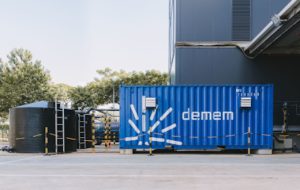
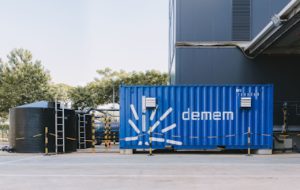
De.mem has its own membrane production facility in Singapore. The company is also active in the field of cooling water treatment and offers services and chemicals for the ongoing operation of cooling systems.
"Our regional presence facilitates collaboration with plant manufacturers and operators, shortens transport routes, and creates the conditions for rapid technical support," says De.mem CEO Andreas Kröll. "With its modular water treatment systems and its experience in industrial cooling water treatment, De.mem is thus well-positioned to benefit from the increasing demand for efficient water technology in Southeast Asian data centers."
Source: De.mem Limited