Technical Article: Designing Diaphragm Valves for Decades of Service Life
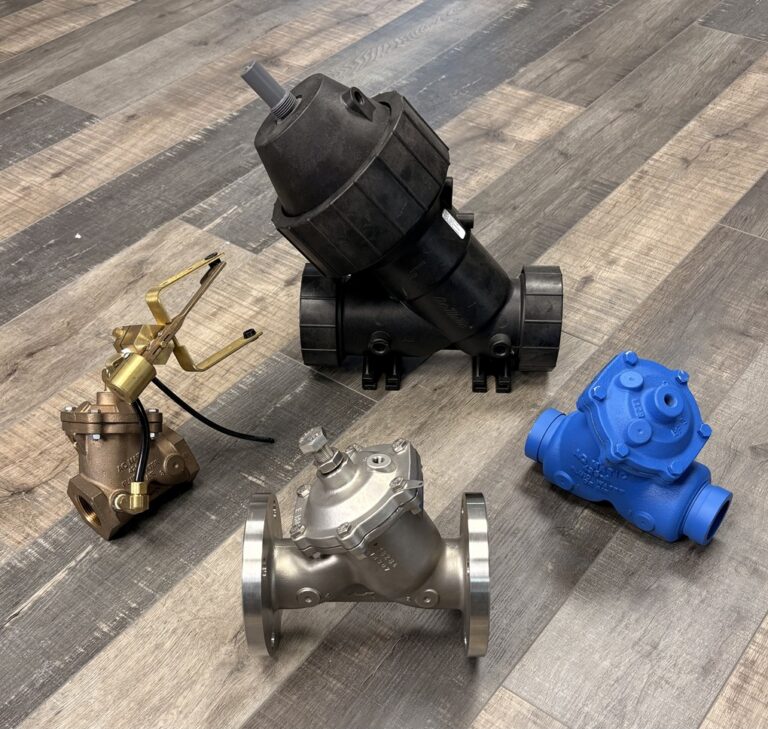
Body and elastomer materials should be selected around piping material, process chemistry, temperature, pressure, and cycling requirements rather than treated as interchangeable options. (Image source: AQ Matic Valve & Controls Company, Inc.)
By Jeremy Josetti, General Manager, AQ Matic Valve & Controls
A control valve may be a small component in a treatment, filtration, or process system, but how it functions affects far more than flow starting and stopping on command. The way it seals influences overall equipment wear. The valve's internal geometry contributes to pressure control. Body and elastomer choices determine how it tolerates corrosion, chemicals, heat, and repeated cycling. Even service access can determine whether maintenance requires a few minutes or a shutdown that involves removing other equipment.
A long valve service life helps reduce unplanned downtime, replacement costs, and maintenance demands while keeping the system operating reliably. Achieving that service life starts before installation by matching the valve’s mechanical design and materials to the pressure, media, flow, cycling, and maintenance conditions it will encounter. These choices help determine how consistently the valve performs and how much it costs to own over time.
Start With the Closing Mechanism
One defining feature of a Y-pattern diaphragm valve is the mechanical advantage created by the relationship between the diaphragm and seat areas. Because the diaphragm has a larger effective surface area than the lower seat area, equal control and line pressures generate greater closing force on the diaphragm side. This geometry helps maintain drip-tight closure across a broad range of operating pressures without requiring a separately sized actuator. That inherent mechanical advantage also helps the valve maintain reliable shutoff as line pressure varies, avoiding the need to compensate for pressure changes by oversizing an external actuator.
Integrating actuation into the valve mechanism also simplifies valve selection. With other valve types, engineers may choose the valve first and then size an actuator based on line pressure, operating conditions, and required closing force. An oversized or poorly matched actuator can produce undesirable closing behavior, while an undersized actuator may not provide enough force. A diaphragm valve that generates closing force through its own geometry removes one variable from the selection process.
The sealing motion is equally important. In a Y-pattern design, the disc closes against the seat with a face seal rather than sliding or rotating across it. Eliminating relative motion at the primary shutoff interface reduces friction and wear, particularly when the process fluid contains abrasive material. Over thousands of cycles, avoiding that rubbing action helps preserve the sealing surfaces and extend the interval between rebuilds. The diaphragm is also isolated from the line fluid, helping protect it from direct exposure to abrasives, acids, and other aggressive media that can accelerate wear.
Match Materials to the Fluid and the System
Material selection should account for both the process environment and the surrounding piping. In many general water applications, cast iron offers a practical balance of structural strength and cost. Brass may be the better fit for copper piping systems, while 316 stainless steel becomes more appropriate when corrosion resistance, chemical compatibility, or high-purity service justifies the additional expense. In systems handling acids, caustics, demineralized water, or chemical dosing streams, thermoplastic bodies can pair naturally with PVC or CPVC piping while providing strong corrosion resistance.
The choice of elastomer can have an even more direct effect on service life because seals and other soft components are repeatedly flexed and exposed to the operating environment. Buna-N, or nitrile, is often a cost-effective option for general water service, while EPDM offers broader compatibility with chemicals such as chlorine and chloramines. Where higher temperatures or acid service are involved, FKM, often known by the Viton trade name, may be a better fit, with service temperatures as high as 250°F. Butyl is commonly selected for caustic media such as sodium hydroxide.
High cycle air service presents a different challenge. In heatless regenerative desiccant dryers, valves may switch between drying and regeneration columns every few minutes, placing repeated demands on the elastomer. An Aflas, or FKM-derived elastomer can provide substantially longer cycle life than standard nitrile, extending the interval between rebuilds and making it better suited to this demanding duty.
Material upgrades should address a known compatibility or duty cycle requirement. Choosing the most expensive material for every application adds cost without necessarily extending useful life, while relying on a familiar material without checking temperature or chemical compatibility can shorten maintenance intervals significantly.
Flow Geometry Is a System Level Decision
A valve can seal reliably and still create unnecessary operating costs if its internal passage forces fluid through a restrictive or turbulent path. In a Y-pattern diaphragm valve, the disc moves nearly out of the flow path when the valve opens. The resulting passage supports relatively high flow with low pressure loss, reflected in a high Cv, or flow coefficient, for a given pipe size.
That high-Cv, low-pressure-loss design gives engineers more flexibility when sizing the system. They can size the piping for an acceptable flow velocity and then choose a matching valve, instead of increasing pipe diameter to compensate for valve restriction. For continuous water flow, about 8 ft/s is a common upper limit, depending on the application. Pressure-drop calculations still matter, but a high-Cv valve is less likely to drive up system losses or require a larger pump. By reducing valve-induced pressure loss, the design can also help lower pumping-energy demands and support more efficient pump selection, improving total cost of ownership.
Closing speed also affects the piping system. Water hammer occurs when moving fluid is forced to change velocity too quickly. In this diaphragm architecture, the upper chamber must fill with control air or water before the valve can close. Because that process takes time, the valve closes more gradually, typically over a few seconds rather than in a fraction of a second. This controlled transition reduces the sudden change in momentum that creates pressure spikes, helping limit water hammer without requiring a separate damping mechanism.
Make Maintenance Part of the Design
Long service life does not mean a valve will never need maintenance. Soft components age, cycle, and eventually wear. A more useful measure of maintainability is whether that wear is predictable, visible, and easy to address before it becomes a larger failure.
In a Y-pattern design, a dynamic O-ring seals around the moving shaft. As the O-ring wears, a small amount of line fluid can enter the lower diaphragm chamber and appear at the vent port. Diaphragm wear can produce the same warning. This visible leakage gives maintenance teams an early indication that service may be needed, often while the valve can still close properly. A technician can then replace the soft parts before the valve loses shutoff performance.
The diaphragm is isolated from the line fluid, which protects it from direct exposure to abrasive particles and aggressive chemicals. The valve also uses a frictionless seat-to-disc closure, so the disc does not rub across the seat during operation. Together, these features reduce two common sources of wear. In high cycle air dryer service, AQ Matic, a leading U.S. manufacturer specializing in diaphragm control valves for water, air, and industrial process systems, reports typical preventive maintenance intervals of approximately 250,000 cycles with Aflas seals. The company's valves are used in heatless regenerative desiccant dryers, where frequent switching makes seal life and predictable maintenance especially important.
AQ Matic also designs its Y-pattern valves for top access, allowing technicians to reach internal components while the valve body remains in the pipeline. On larger valves, this can eliminate the need to unbolt flanges, arrange lifting equipment, and remove a heavy valve from the line. AQ Matic’s application engineers help customers select body and elastomer materials, confirm pressure and flow requirements, and identify applicable certifications before installation. According to AQ Matic, its U.S. manufactured product line is certified by IAPMO R&T to NSF/ANSI 61 and NSF/ANSI 372 for potable water applications.
A reliable valve specification begins with a short list of operating conditions: pressure, temperature, media chemistry, required flow, allowable pressure drop, cycling frequency, piping material, and any certification or domestic content requirements. Those inputs should guide the selection of the body, elastomer, size, and control arrangement as a coordinated system.
The strongest specification minimizes avoidable wear, preserves an efficient flow path, closes at a rate the piping system can tolerate, and makes routine maintenance straightforward. When those decisions are made together, long service life becomes inevitable.