How to Manage Heat in Vacuum Systems?
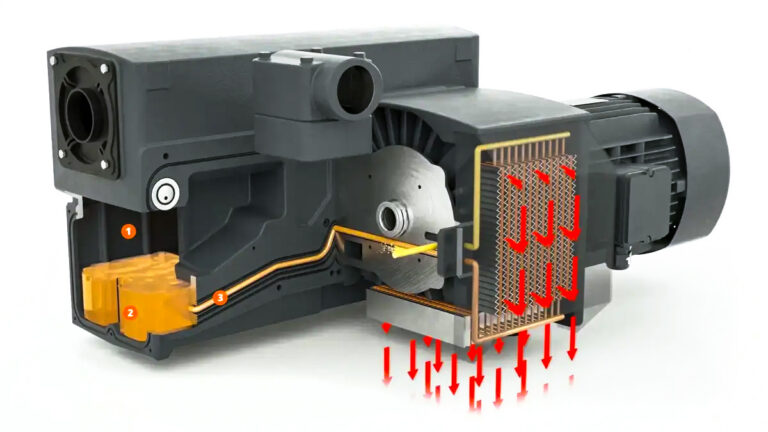
Oil carries heat away from internal components for dissipation. (Image source: Busch Group)
Unmanaged heat also reduces vacuum pump reliability and performance. High temperatures can cause lubrication issues, accelerated wear, and breakdowns, as well as lower pumping speed and increase energy consumption.
How heat affects vacuum pump efficiency
Heat can affect vacuum pump efficiency in several ways:
- Reduced volumetric efficiency: Hot air is less dense than cold air, meaning that fewer molecules are drawn in per pump cycle, reducing effective pumping speed.
- Thermal expansion: Precisely engineered clearances in rotors, screws, and claws can tighten as metal expands when it heats, increasing friction. In extreme cases, this can cause internal contact or a pump to seize completely.
- Lubrication degradation: Heat thins oils and accelerates oxidation, reducing the effectiveness of the lubricant. Over time, this can contribute towards the formation of sludge that clogs passages. In oil-lubricated rotary vane vacuum pumps, the thinner oil also affects the vacuum pump’s sealing ability and can reduce pumping efficiency.
- Seal damage: Prolonged exposure to heat hardens elastomers, which are responsible for maintaining leak tightness. In vacuum pumps, seals are used around shafts, flanges, connections and housings to prevent air ingress and oil leakage. As elastomers lose elasticity and develop cracks, the seal’s integrity is compromised, reducing vacuum performance and efficiency.
- Increased motor load: As friction rises and efficiency drops, the motor draws more current, producing even more heat and risking overheating or failure.
Although some of these issues occur immediately and are easy to identify, others occur over time due to prolonged high temperatures and may be more difficult to spot.
The role of ambient temperature
When vacuum pumps operate in warm environments, the temperature difference between the pump surface and the surrounding air is reduced. This significantly diminishes the vacuum pump’s ability to keep cool. Heat is transferred from the inside of the pump to its outer surface, and from there to the environment. If less heat can be released at the surface, it accumulates inside the pump. As a result, internal temperatures rise and heat rejection becomes less effective.
Enclosed plant rooms are especially problematic, often housing multiple heat-generating machines in confined proximity. Without adequate ventilation, temperatures can exceed the maximum permissible ambient temperature that a vacuum pump is designed to operate in (typically 40 °C). Beyond this, the reliability, performance, and efficiency of the vacuum pump could be compromised.
Effect on air-conditioning systems
Most of the energy consumed by a vacuum pump is converted to heat. Whilst locating pumps in an air-conditioned area can keep them cool, this is an energy-intensive way to do so as it adds a substantial cooling load to the air conditioning system. Air-conditioning systems typically consume 1 kWh of electricity for every 4 kWh of heat that is removed. This means that to remove the heat from a vacuum pump, an air-conditioning system will consume additional energy equivalent to roughly 25% of the pump’s power consumption.
For example, a 10 kW vacuum pump in an air-conditioned space will impose an extra cooling load that causes the air-conditioning system to consume an additional 2.5 kW. This not only raises operating costs but also increases the facility’s carbon footprint and may mean a larger and more expensive air-conditioning system is required. Therefore, relocating vacuum pumps to non-air-conditioned areas is considered best practice.
Managing and reducing heat
The following steps can be taken to manage the heat emitted from vacuum pumps:
- Optimize plant room layout: Keep adequate clearance between vacuum pumps and other equipment to allow airflow. Position exhaust outlets and cooling fans to avoid directing heat toward other machinery.
- Assess and improve ventilation: Assess whether plant room ventilation is sufficient considering the heat load from all equipment in the room. Where required, install additional fans or vents to allow hot air out and cooler air in.
- Redirect exhaust heat: Vent vacuum pump exhausts to the outdoors, cutting in-room heat rejection by up to 35%.
- Consider liquid cooling: Liquid-cooled pumps reject much less heat to the surrounding air, helping to keep vacuum pump and plant room temperatures down.
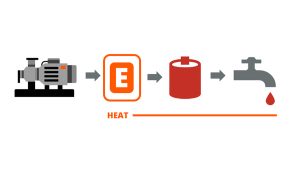
- Install heat recovery systems: On compatible vacuum pumps, heat recovery kits can capture and reuse up to 85% of waste heat for process water heating, reducing ventilation and air conditioning system loads.
Summary
Heat is an unavoidable byproduct of vacuum pump operation. But when heat builds up, it leads to a range of unwanted effects — from reduced volumetric efficiency to increased air conditioning system loads, with both direct and indirect impacts. Although we cannot prevent warm weather, we can manage the ambient temperature in plant rooms to ensure vacuum pumps remain efficient, reliable, and performing at their best.
Source: Busch Group