Control and Pumping Speed: Matching Capacity to Demand for Maximum Efficiency
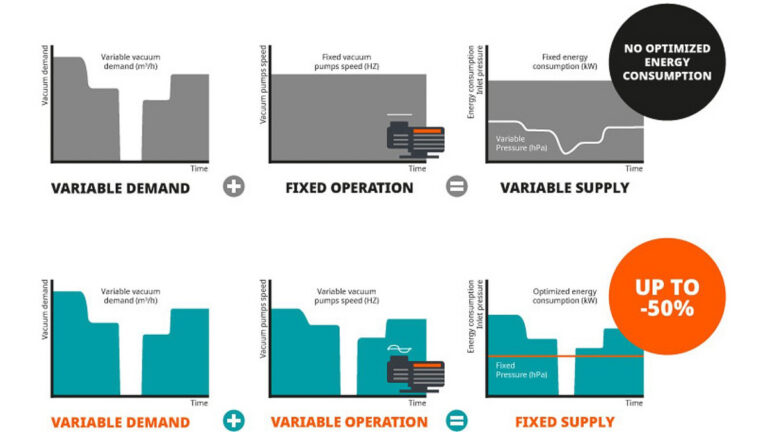
Comparison of vacuum system operation showing variable demand with fixed pump operation versus variable operation with adjusted supply profiles over time. (Image source: Busch Group)
Controlling vacuum pumps in multi-pump systems
Many vacuum processes require more than one vacuum pump to achieve the desired performance. Typically, in such systems, a cascade control system offers a highly efficient solution. Cascade control automatically switches pumps on or off depending on the required vacuum level. This means pumps are only running when they are needed, avoiding unnecessary energy use.
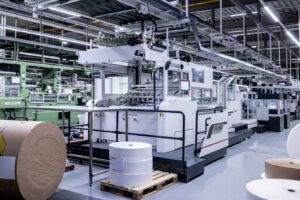
For example, in a packaging process supplied by a central vacuum system with multiple vacuum pumps, the control system can start with one pump in operation. As vacuum demand increases, it can bring additional pumps online. When the process slows down or stops, such as during breaks or at the end of production hours, the control system can shut down pumps completely. This not only saves electricity but also reduces wear on equipment, lowering maintenance requirements.
Matching pumping speed to process demand
Vacuum demand can often fluctuate. A vacuum pump operating at a fixed speed will continue to deliver the same pumping speed even when the demand reduces. This mismatch wastes energy. Even in cases where vacuum demand is stable, there can often still be a mismatch between vacuum demand and pumping speed. This is because the vacuum demand rarely matches the capacity of a vacuum pump perfectly. A vacuum pump operating at a fixed speed is often sized to meet the maximum demand, which may be more than required.
Variable speed drives (VSDs) solve this problem by adjusting the vacuum pump’s rotational speed to match the actual vacuum requirements at any given time. By slowing the pumping speed when demand is low, energy use is reduced. When demand increases, the pumping speed can be increased accordingly. This intelligent adjustment ensures the system delivers exactly what the process needs. No more, no less.
The ECOTORQUE advantage
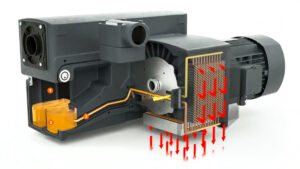
The ECOTORQUE variable speed drive from Busch builds on this concept. It dynamically responds to changes in vacuum demand, maintaining a constant pressure while optimizing energy use. When demand is high, ECOTORQUE can deliver up to 20% higher pumping speed compared to standard 50 Hz fixed-speed operation, maximizing productivity. When demand falls, the drive reduces pumping speed, cutting energy consumption by up to 50%.
Advantages of a variable speed drive
The benefits of a VSD are not just operational. A variable speed drive also reduces mechanical stress on vacuum pumps, extending service intervals and equipment lifetime. This means lower maintenance costs, fewer unplanned stoppages, and improved overall system reliability.
Benefits compared to operation without a VSD:
- Up to 50% energy savings
- Less maintenance and longer vacuum pump lifetime
- Reduced CO₂ footprint
- Increased productivity with +20% pumping speed at 60 Hz
Retrofitting for immediate gains
One of the major advantages of VSD technology is that it can often be retrofitted to existing vacuum pumps. This means you do not have to install new vacuum pumps or a whole new system installation to start saving. In fact, your current pumps can be upgraded to improve performance and efficiency almost immediately. Busch offers retrofit solutions for a wide range of vacuum pump types, making it possible to improve energy efficiency across your operation without major disruption.
Summary
Energy efficiency in vacuum systems is not just about the vacuum pump’s design. It is also about how the pump is operated. Without intelligent control, even the most efficient pump will waste energy when running at full speed unnecessarily. By combining cascade control and variable speed technology, you can create a system that is both responsive and economical, reducing both operating costs and environmental impact.
By using intelligent control strategies and variable speed drives like ECOTORQUE, you can ensure your vacuum pumps only work as hard as they need to. This not only saves energy but also extends the lifetime of your equipment, improves process performance, and reduces maintenance costs.
Source: Busch Group