Construction Site Drainage in Winter: Five Mistakes that Can Prove Costly
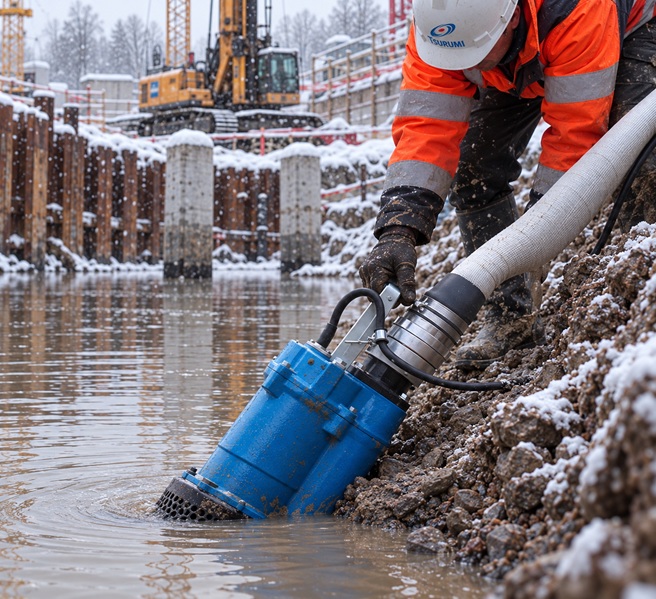
Wet conditions, mud and frost place high demands on construction site drainage. Choosing the right pump and carrying out regular checks help to prevent costly breakdowns (Image source: Tsurumi (Europe) GmbH)
When excavation pits fill up, hoses freeze or pumps become blocked by mud, costs can quickly mount up on a construction site. In autumn and winter in particular, heavy rainfall, low temperatures and difficult ground conditions all come into play. This makes reliable drainage all the more important. Pump manufacturer Tsurumi highlights five typical mistakes that construction companies should avoid during the colder months.
Mistake 1: Underestimating the flow rate
A common mistake begins right at the design stage. If the pump is selected solely on the basis of the average volume of water generated, it can quickly reach its limits during heavier rainfall. It is not only the maximum flow rate that is crucial, but also the actual head required and the pressure losses in hoses and pipes. This is because, with centrifugal pumps, the available flow rate generally decreases as the head increases. Tsurumi therefore recommends designing the drainage system based on the expected peak loads and, where necessary, providing for reserve capacity.
Mistake 2: Underestimating sludge and sand
Water on construction sites is rarely clean. Particularly after heavy rainfall, sand, sludge and abrasive particles can place a considerable strain on the pumps. Using unsuitable equipment in such situations risks premature wear and breakdowns. For applications with a high solids content, Tsurumi offers, for example, the KTZ series, which according to the manufacturer features wear-resistant components and a double mechanical seal in an oil chamber. It is also important to position pumps in such a way that unnecessarily large quantities of settled solids are not sucked in. A suitable pump sump can help with this.
Mistake 3: Failing to protect pipes at risk of freezing
It is not just the pump itself but also the delivery route that requires attention. Ice can form in water-filled hoses, pipes and fittings when temperatures drop below freezing. The consequences range from blocked pipes to damaged components. Systems that are only operated intermittently are particularly at risk. Pipes that are not in use should therefore be drained, and sections at risk of frost should be protected accordingly. Even with submersible pumps, it is essential to ensure that water can drain away at all times. Check valves or non-return valves should be used with care.
Mistake 4: Running pumps unnecessarily in continuous operation
Not every drainage task requires continuous pump operation. If a pump continues to run even when the water level is low, this can consume energy unnecessarily and, under unsuitable operating conditions, put a strain on the equipment. Automatic control systems can help here. For example, Tsurumi’s KTVE series pumps feature an integrated electrode control system that detects the water level and switches the pump on and off as required. This is intended to reduce unnecessary running time.
Mistake 5: Only carrying out maintenance after a breakdown
Particularly in winter conditions, minor technical faults can have significant consequences. Blocked suction inlets, damaged power cables, worn impellers or leaky hose connections compromise operational safety. Regular visual and functional checks are therefore essential. This also includes the inspection of electrical connections and safety devices by suitably qualified personnel. Tsurumi recommends adhering to maintenance intervals and the manufacturer’s specifications, as well as checking systems subject to particularly high wear and tear more frequently.
Prevention ensures safety
These five examples show that reliable construction site drainage does not depend solely on pump performance. Equally important are the correct selection, a well-planned installation and ongoing monitoring. Those who ensure their drainage systems are winter-proofed in good time reduce the risk of unplanned downtime and thus safeguard the project’s schedule.
Source: Tsurumi (Europe) GmbH