U.S. Sludge Dewatering Equipment Market Size Worth USD 1,058.01 Million by 2034
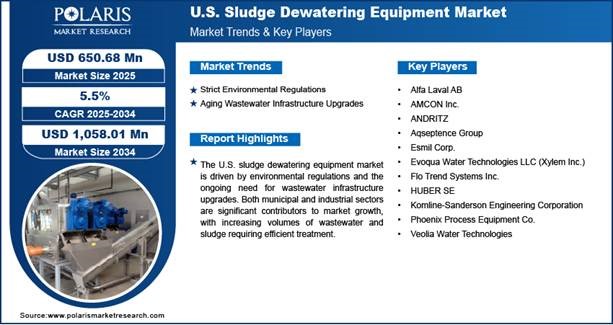
U.S. Sludge Dewatering Equipment Market Size Worth USD 1,058.01 Million by 2034 (Image source: Polaris Market Research)
What is Sludge Dewatering Equipment?
Sludge dewatering equipment is used to separate water from sludge generated during wastewater treatment. It produces a drier material that can be easily handled and disposed of. The conventional thickening process only increases sludge concentration. In contrast, dewatering significantly reduces the liquid content. This makes it essential for modern wastewater management. Its use helps industries meet environmental compliance standards while lowering operational expenses.
What Are the Types of Sludge Dewatering Equipment?
Sludge dewatering requires the use of specialized equipment. Below is an explanation of the most commonly used types:
Centrifuges
Centrifugal dewatering systems operate by spinning sludge at very high speeds. They use centrifugal force to separate solids from water. They are highly effective in handling large volumes and continuous processing. This makes them a preferred choice in municipal wastewater treatment plants and large industrial operations. Centrifuges can achieve high solid content in the final output. They are known for their ability to adapt to varying sludge compositions. However, their high energy and maintenance make them more suitable for facilities with higher budgets and technical expertise.
Belt Filter Presses
Belt filter presses combine gravity drainage and mechanical pressure. They are used to remove water as sludge moves across a series of permeable belts. They are especially common in municipal treatment plants due to their relatively low energy consumption and steady output. Belt presses are appreciated for their continuous operation and ease of use. Additionally, they can handle large sludge flows. The low cost and energy efficiency of belt filter presses make them a practical option for medium to large-scale applications.
Screw Presses
Screw presses make use of a slowly rotating screw. The screw compresses sludge through a narrowing chamber and squeezes out water. This design allows for low-noise operation. It can also process sludge with varying consistencies. Screw presses are increasingly being adopted in both municipal and industrial wastewater treatment plants. They are particularly used in areas where ease of operation and reduced operational costs are priorities.
What Are Major Market Metrics?
The U.S. sludge dewatering equipment market is projected to register sustained growth, according to the latest analysis by Polaris Market Research. The market was valued at USD 617.93 million in 2024. It is projected to register a CAGR of 5.5% from 2025 to 2034.
What’s Driving Market Forward?
Here’s a look at the key factors that are driving market growth:
Stringent Environmental Regulations
Environmental protection is a top priority in the U.S. Environmental Protection Agency (EPA) and state-level agencies that enforce strict regulations on wastewater treatment and sludge disposal. Standards governing landfill use and nutrient management are becoming tighter. This has compelled municipalities and industries to invest in efficient sludge dewatering technologies. Non-compliance with these standards can lead to penalties and reputational damage. As such, organizations are prioritizing equipment that ensures regulatory compliance while minimizing environmental impact.
Rising Municipal and Industrial Wastewater Volumes
The U.S. is witnessing significant urban population growth and infrastructure development. All of this contributes to rising wastewater volumes. Municipal wastewater treatment plants are under increasing pressure to handle larger sludge quantities. Industries such as food processing and pharmaceuticals are producing more sludge as by-products of their operations. This surge in sludge generation is directly driving demand for reliable dewatering systems that can process high volumes efficiently and consistently.
Emerging Trends in the U.S. Sludge Dewatering Equipment Market
Here’s a look at some of the key trends that are shaping the market landscape:
Adoption of Smart and Automated Systems: Digital monitoring and IoT-enabled dewatering systems are being integrated to optimize efficiency, reduce downtime, and provide real-time performance insights.
Energy-Efficient Technologies: Manufacturers are focusing on designs that minimize energy use. The use of energy-efficient technologies is helping utilities and industries reduce operational costs and carbon footprints.
Growing Use of Sludge in Energy Recovery: Biogas production and waste-to-energy projects are creating new opportunities for dewatered sludge. They are making dewatering equipment more integral to sustainable practices.
Modular and Mobile Dewatering Units: Compact and containerized systems are being deployed to remote locations and temporary sites. They offer flexibility and scalability in sludge management.
Conclusion
The U.S. sludge dewatering equipment market is evolving in response to regulatory pressures and rising wastewater volumes. With innovations in automation and modular solutions, dewatering systems are becoming indispensable for modern wastewater management. As industries and municipalities continue to prioritize environmental compliance and cost savings, the adoption of advanced dewatering technologies will remain a key driver of growth in the years ahead.