Progressive Partnerships Will Refresh Water Sector Narrative
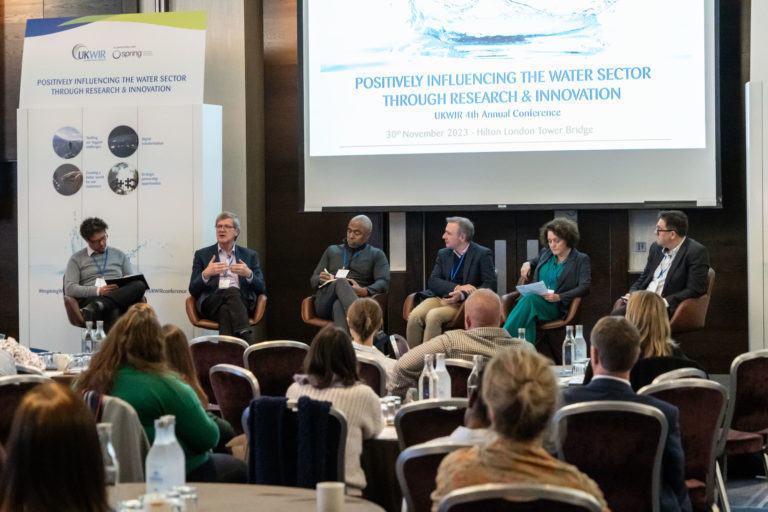
UKWIR 4th Annual Conference, London, 30th November 2023, panel discussion (Image source: UKWIR)
In the first session of the day, Thames Water’s head of media relations Suvra Jans, representing the UKWIR board, spoke of the need to see the threat of climate change as no longer theoretical, but on our doorstep.
“The water sector never had so much interest from customers, politicians and media and with this interest must come an acute sense of responsibility,” said Jans. “As the pressures mount, customers rightly expect us to work together. We must collaborate and use evidence-based research to help change the narrative about what we are doing and transform our image. As they say, if you want to go fast, go alone, if you want to go far – go together.”
Keynote speaker Colin Skellett, chief executive of Wessex Water, focused on the critical importance of encouraging greater investment in infrastructure, and the need to push for broader collaboration.
“We have consistently focused on the wrong thing, such as keeping prices down. The truth is water services are too cheap and the agenda is driven by lobby groups, the media and panicking politicians. As a result, the investment decisions have not always been science-based or focused on environmental need, and this must change.”
Catherine Wenger, water business lead, Arup, called for “brilliant progressive partnerships with communities and citizen scientists.” In her presentation, Wenger discussed the water pressures created by the increasing use of artificial intelligence (AI), community ownership of resources, and the importance of reframing wildlife as a stakeholder.
Journalist Karma Loveday, founder and editor of The Water Report, focused on how recent, negative media attention has eroded public trust, arguing that the key to shifting the narrative is through aligning on a shared plotline for the sector. She also outlined ways the water industry can improve relationships with mainstream media and journalists:
"Water is no longer a silent service,” she said. “There is a real interest and an appetite to know more about the health of our environment and water supplies. The best way forward is to engage with journalists, challenge incomplete narratives and start to build relationships with media.”
Loveday urged water companies not to “defend the indefensible, but instead focus on the positive catchment stories around nature, environment and communities.”
In a panel discussion, chaired by positive news platform Make Water Famous’ founder Natasha Wiseman, Water UK’s director of strategy Stuart Colville, agreed that external communications is a big issue for the sector, “Water companies must work with Water UK and other bodies, to create a single version of the truth, and collaborate with regulators, government and other sources of authority to create meaningful messages that have oversight, integrity, and involve critics in the process.”
Rebuilding trust through diversity
Robert Light, chair of customer champion CCW, explained that trust in the water sector has dropped significantly in recent years.
“CCW polling shows an average 10% drop in trust since 2020, and recent research found that fewer than half of people trust water companies to protect and enhance the environment. Rebuilding that trust will be a key part of changing the narrative for the future,” said Light.
Pete Holland, director of customer and wholesale services at Anglian Water, stressed the importance of considering the perspective of diverse communities when improving customer services, rather than relying on top-down assumptions.
In a panel discussion, Waterwise chief executive Nicci Russell posed a question around diversity and inclusion. “UKWIR research shows that the water sector is less diverse than other sectors, so how can they engage with communities if they don’t reflect customers?” she asked.
Mumin Islam, head of price review at South Staffs Water and Cambridge Water, said the answer was for water companies to enhance equality, diversity and inclusion (EDI) within its workforce, explaining it can improve meaningful engagements with customers.
Strategic direction
UKWIR chief executive Steve Kaye spoke about the strategic direction of UKWIR and its subsidiary innovation platform Spring, over the coming asset management plan (AMP) period 2025-30. According to Kaye, short- term plans include increasing engagement with a wider range of stakeholders to shape the organisation’s research programme, and in the long term - strengthening international collaboration.
Spring was established in 2021 and focuses on collaboration and knowledge-sharing to complement UKWIR’s research focus. Carly Perry, Spring’s managing director, said immediate goals for the organisation include increasing its service offering, and encouraging and facilitating enhanced knowledge sharing.
Tackling challenges
The final keynote speaker of the day, Helen Wakeham, director of water transformation at the Environment Agency, acknowledged the pressures facing the water sector and the need for public support in tackling its biggest challenges.
“We've always faced environmental challenges,” she said, “but now we need to move thinking beyond the here and now into creating future-proofed solutions that people can trust. We must bring the public with us and encourage them to play their part in valuing water, managing demand, and helping stop substances getting into our water – much of which the industry can’t control but public can. To do this, we must identify a common cause, and then meaningfully rebuild public trust.”
An inspiring presentation from Paul O’Callaghan, founder and chief executive of innovation intelligence company BlueTech Research closed the day.
O’Callaghan, who is also executive producer of the award-winning Netflix documentary Brave Blue World, urged the attendees to find the positive, human stories, behind the work they do. He said organisations in water should implement communication strategies that empower and encourage the public to become ‘prosumers’ of water who are more actively involved in the water cycle, for example by incentivising customers to capture water via rainwater harvesting in their homes and businesses.