Protecting Pipeline Coatings Where They Fail First
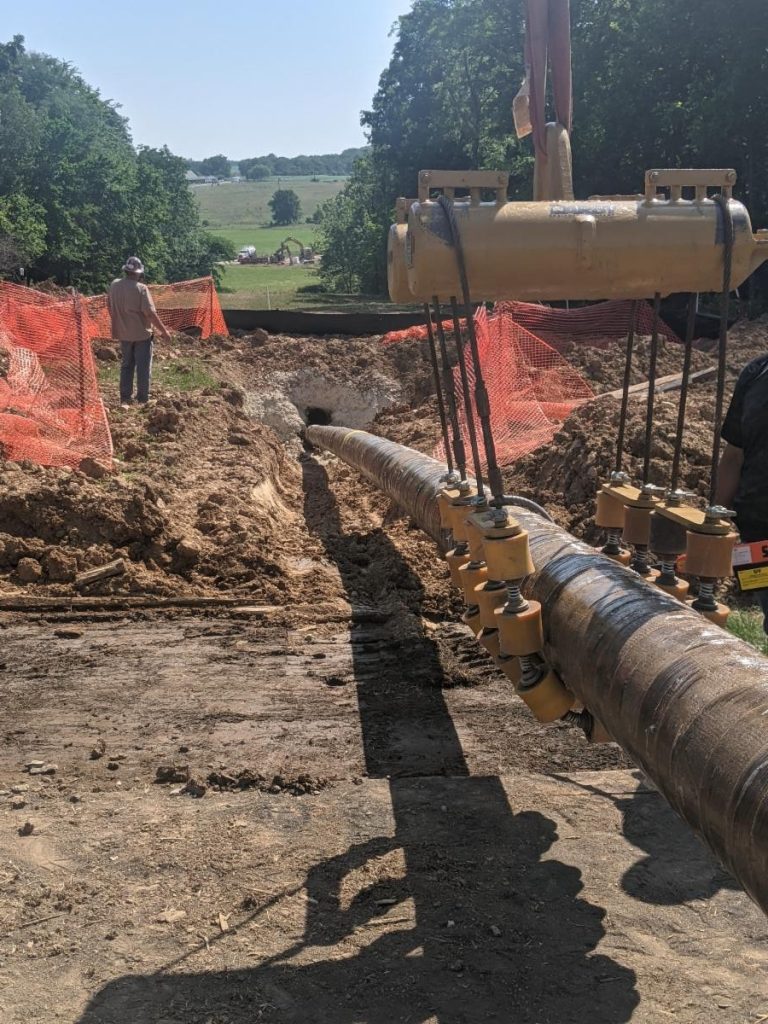
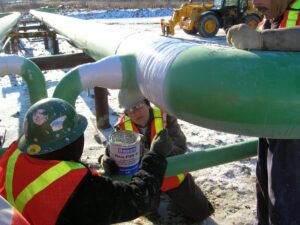
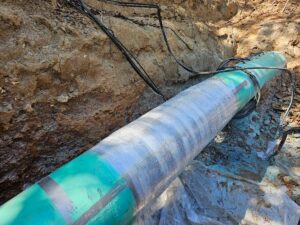
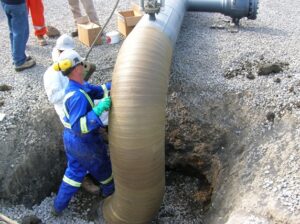
1,200 feet of pipe encapsulated in Denso Bore-Wrap® to protect the mainline coating prior to HDD installation. (Image source: Denso, Inc.)
A pipeline coating can be specified correctly, transported carefully, and selected for the right operating environment, yet still suffer damage during installation that shortens its useful life from the outset. This risk is especially pronounced in horizontal directional drilling (HDD), boring, slip lining, and other trenchless methods where coated pipe must travel through confined paths under sustained mechanical stress.
As trenchless construction has expanded, so has the need to rethink how coatings are protected before a line even enters operation. For owners, engineers, and contractors, the concern is not only selecting a coating with strong corrosion resistance; it is also ensuring that coating survives the journey into the ground.
Why Trenchless Installation Changes the Risk Profile
Traditional open cut installation presents known challenges. Pipe must be handled properly, lowered into place carefully, and protected from rough backfill or impact during placement. These risks are real, but they are relatively visible and easier to control. Trenchless installation introduces a different set of conditions. During HDD pullback, for example, pipe may move through a bore over long distances while subjected to friction, directional stress, side loading, and intermittent contact with rock or irregular surfaces. Instead of isolated handling events, the coating may experience continuous mechanical exposure across the full run.
This distinction matters because not all coating damage appears as obvious scraping. In many cases, localized gouges or impacts create the most serious long term threats. A raised weld area may strike a protrusion in the bore path. A concentrated force point may thin the coating enough to expose steel or weaken the barrier system. Damage can remain hidden while still increasing future corrosion risk and dependence on cathodic protection. As trenchless routes become longer and more ambitious, installation survivability has become a central design concern rather than a secondary construction detail.
Looking Beyond Abrasion to the Full Mechanical Picture
One of the most common mistakes in evaluating protective systems is reducing the issue to abrasion alone. Abrasion resistance is important, but it does not fully represent what pipelines encounter in the field. A more complete view considers four common forces acting together during installation: shear, abrasion, impact, and gouge (SAIG). Shear can stress seams, overlaps, and transitions. Abrasion results from repeated sliding contact. Impact comes from sudden localized force events. Gouge damage occurs when sharp objects or concentrated pressure cut deeper into the protective layer.
A system that performs well in a single abrasion test may still struggle if it cannot absorb impact, resist gouging, or remain stable under directional stress. That is why experienced specifiers increasingly look at a broader performance profile that may include impact resistance, flexibility, fracture toughness, cure consistency, and compatibility with the primary coating system. The larger lesson is straightforward: field conditions are multidimensional, so protective specifications must be as well. A narrow focus on one metric can create false confidence.
What Better Protection Looks Like in Practice
When owners and contractors account for installation stress early, they often shift from thinking about coatings as a single layer of defense to thinking in systems. The anti-corrosion coating remains the core barrier, but a separate mechanical layer may be added when installation conditions justify it.
The most effective outer protection systems typically function as sacrificial barriers. Rather than asking the primary coating to withstand every scrape, strike, or drag event, the outer layer absorbs punishment so the corrosion control layer underneath remains intact. Good systems also help distribute point loads, reduce pullback friction, and maintain dimensional stability while moving through difficult bore paths.
Field practicality matters just as much as laboratory performance. Products that are difficult to install consistently, highly sensitive to weather, or slow to cure can create new risks even if their technical properties are strong on paper. In real projects, working time, cure behavior, climate tolerance, and crew repeatability often determine success. This is where experienced contractors tend to think differently than first time buyers. They understand that the best product is not merely the strongest one, it is the one that performs reliably under jobsite conditions.
When Mechanical Protection Becomes Part of the Specification
As installation environments become more demanding, many project teams are moving beyond a single layer protection mindset. Instead of expecting the anti-corrosion coating to serve as both chemical barrier and construction armor, they are separating those functions. That shift is especially common on projects where retrieval would be difficult, schedule delays would be costly, or subsurface conditions introduce uncertainty. Long HDD crossings, mixed geology, urban utility corridors, environmentally sensitive routes, and rehabilitation work inside existing infrastructure all place added value on preserving coating integrity during installation.
In these scenarios, a dedicated outer wrap can become part of a broader risk management strategy. The goal is not to replace the primary coating system, but to give it a sacrificial mechanical outerwrap during the phase when damage is most likely to occur. This allows engineers to keep the corrosion-control system they trust while adding a separate layer designed for pullback forces, contact stress, and surface abuse. Denso, a global leader in corrosion prevention and sealing technologies, has responded to these needs with solutions such as Bore‑Wrap®, a field‑applied abrasion‑resistant outerwrap designed to protect approved coating systems during HDD, boring, and other mechanically aggressive installations.
Bore-Wrap uses a fiberglass-reinforced, moisture-cured urethane composite structure that forms a hardened sacrificial laminate over coatings such as FBE, shrink sleeves, liquid epoxies, 3LPE, and 3LPP. Its stated performance focus includes resistance to impact, gouge, abrasion, and fracture, closely aligned with the real world combination of forces many trenchless projects encounter.
Its rapid cure profile and broad application temperature range also reflect a practical truth of field construction: even high-performance materials must be installable under changing weather and schedule pressure. Denso additionally emphasizes training and technical support across its corrosion prevention portfolio, reinforcing the idea that specification quality and installation quality are closely linked.
The New Standard Is Lifecycle Thinking
The pipeline industry has traditionally separated construction decisions from long term integrity decisions. That distinction is becoming less useful. Damage introduced during installation can increase maintenance costs, inspection needs, cathodic protection demand, and repair exposure for years afterward.
The better approach is lifecycle thinking from the start. That means evaluating not only the operating environment, but the route, soil conditions, installation method, pull length, and recoverability if something goes wrong. In many cases, the most economical decision is not minimizing upfront material cost, it is reducing the probability of hidden damage before the line is ever commissioned. As trenchless methods continue to grow, pipeline protection will increasingly be judged by one simple question: not just whether a coating lasts in service, but whether it arrives there intact.
By: Ron Raphoon, ARO Coating Specialist, at Denso, Inc.
Source: Denso, Inc.