Armstrong Industrial Supplies Reliable Pre-Heat Solutions at a Gas Interconnector in Ireland
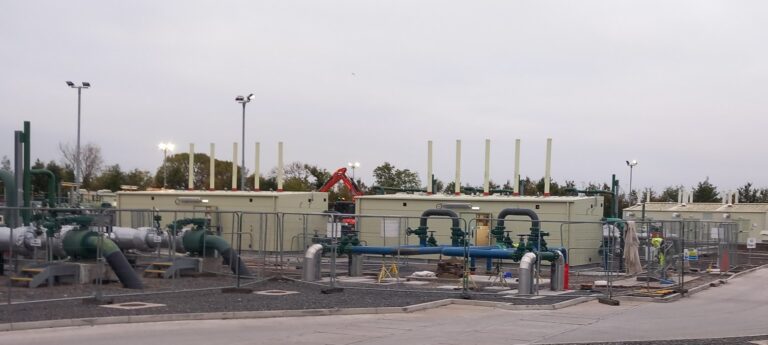
The 3 MW boiler house units at the gas interconnector site in Ireland, connected to the existing pipework ahead of commissioning. (Image source: Armstrong Fluid Technology)
The boiler houses provide the function of pre-heating the incoming gas before it undergoes pressure reduction. The additional boilers allow Ireland to meet its projected gas demand for the next regulatory period.
Armstrong Industrial: Gas had initially supplied the current 9.5 MW system at this site in 2022 and delivered the latest two on a fast-track timeline. The upgrade has increased the heating capacity on site by 60% – bringing it to a total of 15.5 MW.
Critical infrastructure to meet demand for capacity increase
Located on Ireland's coastline, the interconnection point is part of critical infrastructure for the importation of gas from the United Kingdom. Having conducted a gas market demand assessment, the operator required that the capacity at this interconnector be increased.
The addition of Armstrong's boilers allowed the capacity of the interconnector to be raised from 6 million to 6.9 million standard cubic meters of gas per day.
On specification, on time
The project required Armstrong Industrial to design, build and test the two 3MW boiler houses at short notice, aligning strictly to the customer's specifications.
The units were to be delivered to site, tested, commissioned and handed-over to the customer by the end of October 2025 – in time for the planned increase in gas flows into Ireland.
The project also required that the new boiler houses were integrated with the two existing units that Armstrong had supplied in 2022 – and with the existing master control panel.
How Armstrong Industrial did it
In preparing the proposal for the customer, the division conducted an assessment and planning exercise to ensure that specifications could be met in the required timeframe.
Armstrong Industrial then applied techniques and technologies used in its boiler designs. In this project, the division made use of its standardised designs of boilers, pumps and controls – technology it has applied on previous projects.
Safety measures are incorporated into Armstrong Industrial's designs; in this project, the division used low-NOx (nitrogen oxide) condensing boilers and ensured that condensate is neutralised to a pH level of 6-8 prior to discharge. During boiler commissioning, the division adjusts the gas valves to provide the optimum carbon dioxide setting, and records these levels to demonstrate compliance with the boiler manufacturer's recommendations.
Fast-track timeline
Once the tender request was received from the customer in October 2024, the division's Offerings Manager prepared and submitted a full tender return pack within 10 days – and responded to the customer's technical clarifications the following month.
After Armstrong Industrial was advised that it had won the tender, and the purchase order was received in February 2025, it was able to submit its design calculations and indicative drawings within a month. This paved the way for design approval in April 2025, and the division began procurement activities immediately.
By July 2025, manufacturing had begun. The project's key challenge was the urgent timeframe for design and manufacturing. The units specified were large enclosures – measuring 10 m long by 3.7 m wide and 3.2 m high excluding the flue terminals – occupying considerable floor space in Armstrong's manufacturing facility.
The boiler houses were ready for the customer to inspect in September 2025, at Armstrong's dedicated factory in Droitwich. The same month, the units were transported to site, and commissioning was conducted the following month by Armstrong Industrial's service team.
Results
The process is designed to keep the gas outlet temperature from the site at more than 2°C. The boilers are modulated at the appropriate output to achieve this constant temperature (after pressure reduction). The site continues to achieve this constant outlet temperature, but now has more heating capacity available to accommodate future increases in gas flow (load demand).