2025 Geared Motor Market: Leading Manufacturers Maintain their Dominance
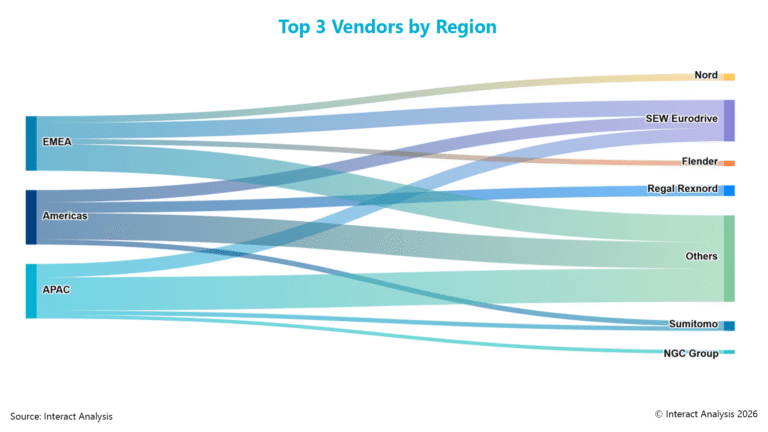
The chart shows the three leading suppliers in each region and does not represent each manufacturer’s full geographic footprint (Image source: Interact Analysis)
Beneath this overall stability, however, regional competitive dynamics varied considerably. SEW-Eurodrive maintained a leading position across all three major regions, but the balance of competition differed sharply between EMEA, the Americas and Asia-Pacific.
Top 19 manufacturers account for 75% of the market
The geared motor and industrial gear market has developed into a relatively stable and concentrated competitive landscape. In 2025, 19 manufacturers each held more than 1% of the market. Together, they accounted for approximately 75% of global revenue, a decrease of just 0.2 percentage points from 2024.
The market also has a pronounced gap between its largest supplier and the rest of the field. Only one manufacturer (SEW-Eurodrive) generated more than $3 billion in annual revenue in 2025. By comparison, each of the manufacturers ranked second through sixth generated between $500 million and $1 billion.
Of the 19 manufacturers with market shares above 1% in 2025, eight were headquartered in EMEA, seven in Asia-Pacific and four in the Americas. Manufacturers headquartered in the Americas and Europe generally outperformed their Asian counterparts during the year.
Manufacturers in the Americas benefited primarily from a strong recovery in regional demand. This created a more favorable environment for local suppliers and supported revenue growth among the leading players.
Leading European manufacturers benefited from their broad international presence. Recovering demand in the Americas supported regional sales, while the euro’s appreciation against the US dollar increased reported revenue when converted into dollars.
SEW-Eurodrive leads globally, but regional competitive structures differ
The top three manufacturers accounted for more than 50% of the market in both EMEA and the Americas in 2025. Despite similar concentration levels, the two regions had markedly different competitive structures:
- EMEA: SEW-Eurodrive accounted for nearly 30% of the market. Its share was larger than the combined share of the manufacturers ranked second through fourth, underlining its clear market leadership.
- Americas: The market was more evenly balanced. SEW-Eurodrive held a share of more than 20%, while second-ranked Regal Rexnord accounted for nearly 20%. Regal Rexnord’s presence in heavy-duty industrial gearboxes supports its strong position across the region.
- Asia-Pacific: SEW-Eurodrive led the market with a share of nearly 25%. Beyond the market leader, however, the supplier landscape was considerably more fragmented.
China, the region’s largest national market, has a fragmented supplier landscape that includes many local manufacturers. Localization and the substitution of imported products continue to create growth opportunities for Chinese suppliers.
Overseas expansion is also becoming more important. Chinese gearbox manufacturers are increasingly following domestic OEM customers into international markets and supplying components for their overseas operations.
Japan, the second-largest market in Asia-Pacific, is mature and relatively closed to new entrants. Domestic manufacturers have maintained leading positions through established customer relationships, strong brands and mature distribution networks. Sumitomo held more than 40% of the Japanese market in 2025, giving it a clear lead.
Outlook
The competitive landscape remained stable in 2025, with SEW-Eurodrive leading across EMEA, the Americas and Asia-Pacific. However, the structure of competition varied by region. EMEA and Asia-Pacific had clear single-market leaders, while the Americas had a more balanced two-player structure.
According to Interact Analysis, leading manufacturers are likely to retain their positions in the near term, but their competitive priorities are evolving. Multinational suppliers will need to combine global reach with stronger localization in key markets. Chinese manufacturers, meanwhile, are expanding internationally, often alongside domestic OEM customers.
As industrial supply chains become more geographically diverse, competition is moving beyond products and pricing. Local manufacturing capacity, customer support and resilient supply-chain management will play a growing role in determining future market positions.
Source: Interact Analysis