Product Quality Along the Entire Line: KHS Process Technology for Dosing and Blending
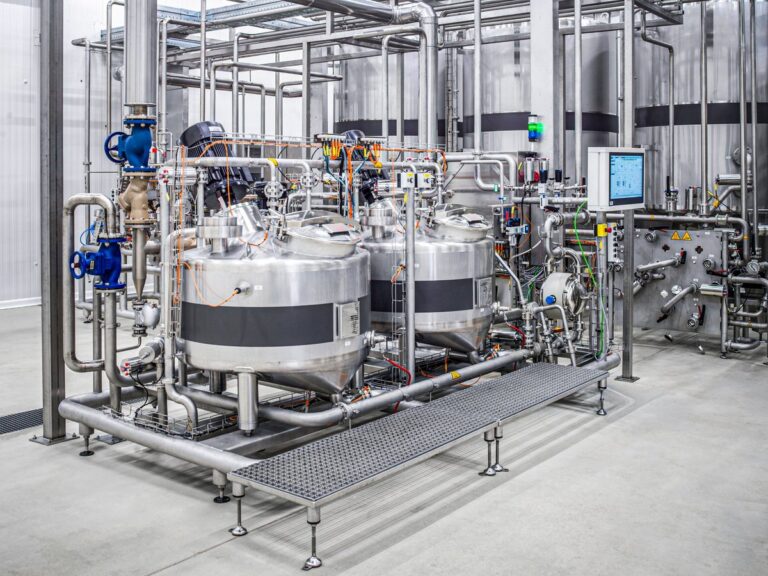
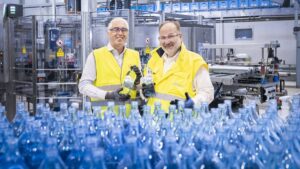
The Innopro Batchmix blending and dosing system adds further ingredients to the sugar syrup such as flavoring, acid or caffeine (Image source: KHS GmbH/ Frank Reinhold)
In beverage production, process technology lays the foundations for taste and product quality, emphasizes Tobias Cherdron, product manager for process technology at KHS. “It’s essential that all components are perfectly coordinated with one another, that they satisfy specific customer requirements and function totally reliably.” KHS pursues this strategy with its process technology portfolio that ranges from raw materials acceptance to the ready-to-bottle product. Modular in design and freely combinable, the spectrum includes filtration, sugar dissolving, dosing, blending, deaeration, carbonation, heating and cleaning, among other functions.
Process Technology Tailored to the Entire Line
The manufacture of soft drinks illustrates how this interaction of the various components works in practice. Syrup forms the basis here that customers either buy in ready-made or produce themselves from sugar. When fabricated on site, at the first stage sugar is dissolved using the Innopro Delta Jet B machine or, for larger batches, the Innopro Delta Jet C. Following this, various blending and dosing modules such as the Innopro Batchmix add further ingredients to the syrup: flavoring, acid or caffeine, for instance. At BrauBeviale, KHS demonstrated how these batch-wise processes are technically realized on an exhibit flavor-handling unit. This manually empties 25-liter containers and doses flavoring using a pump into a continuous blending system like the Innopro Contimix C.
With the Innopro Paramix C and Contimix C, KHS provides two machines for beverage deaeration, blending and carbonation. Which variant is used depends primarily on the method of syrup manufacture and respective product range. The first is a compact unit tailored to customers who make large quantities of their own syrup and have a broad product spectrum. The Innopro Contimix C, on the other hand, is aimed at users who have just one to two main products or have no or only a small syrup room. This combines simultaneous dosing of up to ten syrups and other ingredients stored in connected dosage tanks and the subsequent blending of all components in the main machine to produce the finished beverage.
Automation and Material Traceability
The hygienic design of the machines, their high degree of automation and precise control systems help to ensure consistent product quality and process reliability. “Automated, recipe-controlled process reproducibility, dependable material traceability and data evaluation and archiving are features that are in particular demand by customers,” states Cherdron.
For materials management KHS relies on Plant iT, the process control system from ProLeiT. It’s used on the Innopro Contimix C and in syrup rooms, among other equipment. Each beverage component has a bar code. When the operator moves a component to a specific place on the machine, they scan both the slot and the component using a handheld scanner. The system then automatically recognizes whether the container is in the right place or not or whether the right ingredient is being added to the tank, for example. This prevents incorrect components from entering the product. What’s more, ProLeiT enables data to be archived.
KHS also uses consistent sensor and actuator technology with digital communication in its process technology. Automated fault diagnosis via the Ethernet or IO-Link helps to detect disruptions in good time and precisely locate them so that they can be specifically remedied.
One particular challenge in process technology is ultimately the complex interaction of the various components. To plan this, KHS makes use of digital 3D machine and piping planning. “Machines, tanks and piping conduits must be precisely coordinated with one another. Thanks to extensive 3D engineering and many years of consultancy expertise, we can implement the respective customer specification transparently and according to demand,” says Cherdron.
Expansion of International Production Capacities
According to KHS, the demand for soft drinks and mixed beer beverages across the globe has increased over the last few years. This trend is noticeable at KHS, too, Cherdron says. “Our order volume for process technology has undergone a very positive development in the past few years. A clear rise in this segment is emerging for 2026.”
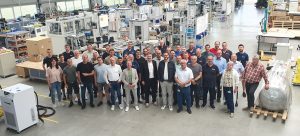
With a view to market growth, KHS is expanding its worldwide engineering and production capacities. The aim is to harmonize the product portfolio across all locations in order to offer national and international customers a consistently high level of quality. In the future, the Innopro Paramix C blending system will also be manufactured at the KHS factories in São Paulo, Brazil, and in Waukesha, USA, for instance. Intersite cooperation is intended to permit specific market and customer requirements to be better integrated into global products. At the same time, future worldwide use of systems developed regionally, such as sugar decolorization modules, will be possible. Cherdron sees advantages in this: “When we produce locally, we can respond even more efficiently to specific market demands. Our production sites employ qualified personnel with a high level of specialist expertise, also regarding service. They give us proximity to our customers, allowing us to be a close and reliable partner to them. This makes coordination easier, especially of the process technology systems used in day-to-day business operations.”
Source: KHS GmbH