Bürkert Introduces 2/2-Way Dosing Valve for Laboratory and Analytical Systems
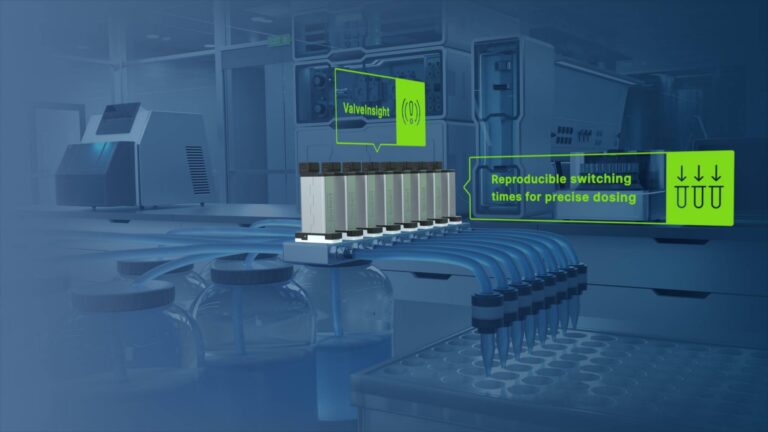
Precision dosing starts with reproducible switching times. (Image source: Bürkert Fluid Control Systems)
Bürkert has released the Type 6732, a 2/2-way solenoid valve with media separation. It is intended for dosing small amounts of liquid in laboratory, analytical and industrial systems. The valve has a small internal volume, which helps with small dosing quantities and with passing them on to the next stage of the process.
Lorentz actuator
Like other valves in the Whisper Valve range, the Type 6732 uses a Lorentz actuator. According to the manufacturer, it switches faster and repeats more reliably than conventional solenoid actuators. It also uses less power and makes less noise. Little heat passes from the valve into the medium, which matters for temperature-sensitive fluids. Bürkert says the flow path is designed so the valve is easy to flush.
Applications and design
The valve is meant for applications such as PCR analysis, pipetting arms in bioanalytics, oligonucleotide synthesis and the filling of sensitive products. It is aimed at both point-of-care and point-of-use applications. The valve is 7 mm wide, so it fits into devices with little space. It can be ordered in several materials to suit different liquids and gases. The valve can also be used under vacuum.
Condition monitoring
The valve can be used with Bürkert’s ValveInsight function. ValveInsight analyses the actuator’s current profile to monitor how the valve switches, without additional sensors. This lets it detect deviations at an early stage, in both mobile and stationary equipment.
Source: Bürkert GmbH & Co. KG